
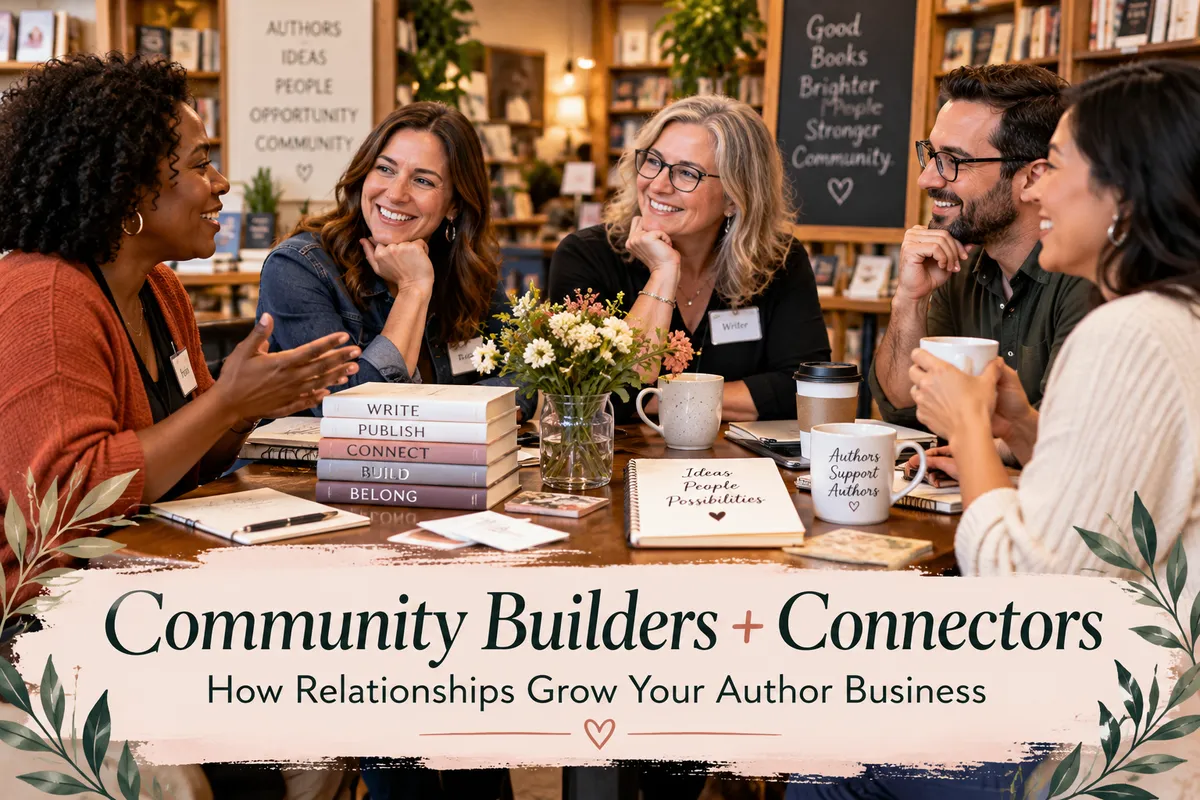
Community Builders + Connectors: How Relationships Grow Your Author Business
How Relationships Grow Your Author Business
WEEK 3 OF THE AUTHOR VISIBILITY SERIES
Last week, we explored two Author Visibility Types that build visibility through ideas:
The Authority Author and The Content Creator.
This week, we're moving from ideas to people.
Meet:
The Community Builder and The Connector.
These two visibility types understand something that can be easy to forget when we're buried in websites, algorithms, social media posts, sales numbers, and marketing plans:
Author businesses are built around people.
Community Builders create places where people feel they belong.
Connectors create relationships that often lead to opportunities.
Which gives us two important truths:
Community creates belonging.
Connection creates opportunity.
And sometimes one unexpected day at a literary festival can lead to both.
Two Relationship-Driven Author Visibility Types
A Community Builder brings people together around a shared interest, purpose, message, or experience and creates an environment where relationships can grow.
A Connector naturally builds relationships, introduces people, stays in touch, and recognizes opportunities for people to benefit from knowing one another.
Community Builders often think:
“How can I create a place where these people belong?”
Connectors often think:
“You two really need to meet.”
Many authors are a combination of both.
And those strengths can become powerful visibility tools because people tend to remember genuine relationships much longer than they remember another promotional post.
Sometimes the Opportunity Isn't the One You Expected
Last spring, I was excited to participate in a local Literary Festival.
Sounds awesome, right?
A book lover's delight.
There were more than 40 authors gathered outside a local library, and we had a great turnout.
There was just one small problem.
Most of the attendees were very young children and their parents.
A couple of well-known toddler characters were getting all the love.
I don't write children's books. I did not sell one book. Not one.
From a book-sales perspective, the event was basically a very pleasant picnic with inventory.
But I was there with my teenage granddaughter, so the day was already a win.
And while I sat there watching all these authors around me, another thought started forming.
What do the authors in our area need?
I'm really good at bringing people together.
Actually, it's my jam.
And I realized something was missing.
We needed a place where local authors could:
Meet one another
Build relationships
Learn about the business side of writing
Share resources
Discover opportunities
Encourage each other
We needed a networking community.
And if one didn't exist...
Maybe I could create it.
When the Community You Need Doesn't Exist
Instead of going home disappointed about my zero-book-sales day, I started walking from booth to booth.
I introduced myself to the other authors.
I offered them my business card with information about my free Author Resources and the Authorpreneur Compass blog.
In return, authors who were interested gave me their contact information so I could begin organizing a local networking group.
The idea eventually became the Hill Country Authorpreneur Network.
The purpose wasn't:
“How can I gather a bunch of people so I can sell something to them?”
It was:
“What could we create that would genuinely benefit authors in our area?”
That's an important difference.
There wasn't an existing community that fit what I envisioned.
So rather than waiting for someone else to build it—or moaning because it didn't exist—I decided to create the opportunity.
And that's the beautiful thing about community.
When it's done well, everybody benefits.
What Does a Community Builder Do?
A Community Builder doesn't simply collect followers.
She creates belonging.
There's a difference.
You can have thousands of followers who barely know you.
Or you can have a smaller group of people who:
Know why they're there
Share common interests
Interact with one another
Support one another
Learn together
Return because the community matters to them
Marketing author Seth Godin has written extensively about this idea.
In his book Tribes: We Need You to Lead Us, he explores how people gather around shared ideas and how leadership can bring those people together.
That idea resonates strongly with authors.
Because your readers may have more in common than simply owning the same book.
They may share:
A faith
A struggle
A profession
A hobby
A cause
A season of life
A genre they love
A problem they're trying to solve
A desire to learn or grow
Your book may be what introduces them to you.
Your community may be what keeps them connected.
Audience or Community?
Here's an important distinction.
An audience listens to you.
A community connects with you—and with each other.
Both have value.
But they aren't the same thing.
If you post something and 1,000 people read it, you have reached an audience.
If readers begin talking with you, responding to one another, sharing experiences, encouraging each other, and returning because they value the relationships...
You're beginning to build community.
A Community Builder asks:
“How can I create meaningful interaction instead of simply generating attention?”
Signs You May Be a Community Builder
You may lean toward the Community Builder visibility type if:
You naturally make people feel welcome.
You notice when someone is standing alone.
You enjoy gathering people around a shared interest.
You like encouraging conversation.
You remember what people tell you.
You enjoy creating groups, events, or gatherings.
You care whether people connect with one another, not only with you.
You often think, “We should get everyone together.”
You may already be building communities without labeling them that way.
Perhaps you've organized:
A book club
An author group
A church group
A Facebook group
A mastermind
A retreat
A reader team
A monthly lunch
A workshop community
A newsletter community
Sometimes we discover our visibility strengths by noticing what we've been doing naturally for years.
What Change Does a Community Builder Create?
A Community Builder often creates change through:
Belonging and encouragement.
People may leave an interaction with you thinking:
“I found my people.”
or
“I'm not doing this alone.”
That's meaningful impact.
Visibility doesn't always mean getting your face in front of more people.
Sometimes it means creating a place people genuinely want to return to.
But Someone Has to Make the First Connection
This brings us to the second type.
The Connector.
And this one may have started for me very early.
I'm fairly certain I was introducing my mom to the delivery team moments after I was born.
😂
Connecting people has always felt natural to me.
I love meeting people.
I love learning what they're doing.
And I really love those moments when I realize:
“You need to meet this person.”
Then I get to watch a relationship develop into something beneficial for both people.
That's one of my favorite things.
What Does a Connector Do?
A Connector sees possibilities inside relationships.
A Connector might hear someone say:
“I'm looking for a podcast that talks about Christian fiction.”
And immediately think:
“I know someone you should meet.”
Or:
“I'm looking for a speaker on this topic.”
And think:
“Wait. I met someone at a conference who would be perfect.”
Or:
“I need a bookstore willing to host local authors.”
And remember a conversation from six months earlier.
Connectors don't merely collect contacts.
They remember connections.
That's a critical difference.
A stack of business cards isn't a network.
A contact list isn't necessarily a relationship.
And 3,000 LinkedIn connections don't automatically mean 3,000 people would recognize your name if you walked past them at the grocery store.
Real connection requires interaction.
Networking Doesn't Start With “What Can You Do for Me?”
This is one of the most important lessons I've learned.
When I meet someone at a conference or event and I'd like to stay connected, I try to reach out before the event is even over.
That might be an email or text that simply says how much I enjoyed meeting them.
Or I may congratulate them on something they've accomplished.
The first message isn't:
Here's everything I sell.
It isn't:
Can you introduce me to your agent?
It isn't:
Would you like to join my mailing list, hire me, buy my book, host me on your podcast, and possibly name your next child after me?
It's simply:
I enjoyed meeting you.
Because connection should begin with genuine interest in the other person.
Not with an agenda.
Make Follow-Up Easier on Yourself
Conferences can be wonderful.
They can also become a blur.
You attend workshops.
Meet people.
Collect business cards.
Take notes.
Have hallway conversations.
Promise yourself:
I'll definitely remember all of this.
And then you get home.
No.
You won't.
I've learned to take photos of my notes and use ChatGPT to turn them into an organized follow-up list.
I can identify:
People I want to contact
Things I promised to do
Resources I want to investigate
Opportunities worth exploring
Easy actions I can complete quickly
Longer-term follow-up items
Then I ask for those tasks to be prioritized, including some low-hanging fruit I can accomplish right away.
That simple process has taken my connection game to another level.
Because meeting someone isn't the hard part.
Remembering to follow up is where many connections disappear.
The Connector's Secret Weapon: Follow-Up
Think about all the people you've met during the last year.
At:
Conferences
Book events
Workshops
Church
Author groups
Networking events
Online communities
Speaking events
Podcasts
Professional organizations
How many of them did you genuinely follow up with?
Not because you wanted something.
Simply because you wanted to continue the relationship.
Sometimes we spend all our energy trying to find new contacts while ignoring people we've already met.
Before attending another networking event, you may want to ask:
Who is already in my world that I should reconnect with?
Friends Are Like French Fries
Here's my highly scientific relationship philosophy:
Friends are like French fries. You can always use one more.
Seriously, though, you never know what a genuine relationship may eventually become.
Someone you meet today might someday:
Refer a client
Invite you to speak
Recommend your book
Introduce you to a podcast host
Connect you with a bookstore
Become a collaborator
Become a mentor
Become someone you mentor
Become a close friend
And you may do the same for them.
But if you enter every relationship asking:
“What can this person do for me?”
People usually feel it.
Instead, try asking:
“How can I be genuinely interested in this person?”
Good things often grow from there.
What Change Does a Connector Create?
A Connector often creates change through:
Relationships and opportunity.
Someone may walk away thinking:
“That introduction opened a door.”
or
“I never would have found that opportunity without that connection.”
That's why genuine networking can become an important author visibility strategy.
You don't have to know everybody.
You need to build real relationships with the people you do know.
COMMUNITY + CONNECTION = RELATIONSHIPS THAT GROW
Community creates belonging.
Connection creates opportunity.
Community gives people a place to gather.
Connection helps relationships begin.
Together, they can create:
Friendships
Referrals
Collaborations
Speaking opportunities
Podcast invitations
Reader loyalty
Professional partnerships
Encouragement
Shared learning
New ideas
Opportunities no marketing plan could have predicted
People aren't stepping stones.
They're people.
Build relationships because people matter.
Then allow opportunities to grow naturally from genuine connection.
Are You a Community Builder, Connector—or Both?
You may lean strongly toward Community Builder.
You love creating places where people gather, but networking one-on-one may require more intentional effort.
Or you may be a Connector.
You can meet people all day long, but have little interest in running a group.
Or perhaps you're both.
That's a powerful combination.
A Community Builder + Connector might:
Start an author group
Host reader events
Organize networking lunches
Build collaborative projects
Develop partnerships
Introduce authors to opportunities
Create retreats
Lead online communities
Host book clubs
Connect speakers with organizations
Gather people around a shared cause
The Hill Country Authorpreneur Network grew from exactly that overlap for me.
I saw people.
I saw a need.
I started making connections.
Then I began creating a place for those relationships to continue.
Don't Wait for Someone Else to Create the Opportunity
This is another lesson from that Literary Festival.
It would have been easy to say:
“I wish there were a good networking group for authors around here.”
Then go home.
End of story.
Instead, I asked:
“Could I create it?”
Authors sometimes assume opportunities are things that happen when somebody else chooses us.
Someone invites us to speak.
Someone asks us onto a podcast.
Someone organizes an event.
Someone creates the group.
Someone notices us.
But sometimes the next opportunity begins when you create the room.
If you've read my Authorpreneur Compass blog about creating your own opportunities, this is that principle in action.
Create Your Own Opportunities Blog
Don't simply ask:
“Where can I get invited?”
Sometimes ask:
“What could I create that would benefit everyone involved?”
That's a very different question.
Try This: The Relationship Visibility Exercise
If you're completing the four-week Author Visibility Field Test from Part 1, this week's experiment focuses on Community and Connection.
Try one activity from each.
Community Builder Experiment
Create one small opportunity for people to interact.
You could:
Ask a meaningful question in your newsletter.
Start a conversation on social media.
Invite several authors to coffee.
Host a short online discussion.
Organize a small reader gathering.
Ask members of an existing group to share their experiences.
Then rate:
Enjoyment
Ease
Response
Potential
Also ask:
Did people connect with each other—or only with me?
That's useful information.
Connector Experiment
Choose one relationship-building action.
You could:
Follow up with someone you recently met.
Reconnect with an old contact.
Introduce two people who would benefit from meeting.
Attend an author gathering.
Congratulate someone on an accomplishment.
Send a simple “I enjoyed meeting you” message.
Then rate:
Enjoyment
Ease
Response
Potential
And ask:
Did this feel like relationship-building—or did it feel transactional?
If it felt transactional, adjust your approach.
A Simple Conference Follow-Up System
Try this after your next conference or author event.
Before You Leave
Connect with the people you most want to remember.
Send a quick:
“It was so nice meeting you today.”
Now their information isn't simply sitting on a card in the bottom of your tote bag.
Capture Your Notes
Take photos of:
Workshop notes
Business cards
Action items
Ideas
People you want to contact
Create Your Follow-Up List
Organize your notes into:
People
Tasks
Opportunities
Resources
Follow-ups
Start With Low-Hanging Fruit
Choose two or three quick actions.
Send the email.
Connect on LinkedIn.
Share the promised resource.
Make the introduction.
Don't wait until you've developed the world's most sophisticated networking system.
Just follow up.
Don't Measure Relationships Like Social Media Metrics
This matters.
If you introduce two people and nothing happens immediately, that doesn't mean you failed.
If only four people attend your first gathering, that doesn't mean you don't have a community.
If one person replies to your email, that doesn't mean your effort was worthless.
Relationships grow differently than algorithms.
Sometimes slowly.
Sometimes unexpectedly.
Sometimes years later.
You can't always measure connection with:
Likes
Followers
Shares
Sales
Attendance
Sometimes success looks like:
“I'm glad we met.”
That's a pretty good beginning.
Waypoint Challenge: Create One Connection This Week
Choose one:
Build Community
Create one opportunity for people to interact around something they share.
or
Make a Connection
Reach out to one person you want to know better—or introduce two people who should know each other.
Then notice:
Did you enjoy it?
Did it feel natural?
Did someone respond?
Did it create belonging?
Did it create an opportunity?
Would you do it again?
Write down what happened.
You'll use those observations when we get to Part 2: The Experienced Author Visibility Quiz.
Frequently Asked Questions About Community Building and Networking for Authors
What's the difference between an audience and a community?
An audience primarily receives information from an author. A community includes interaction and relationships among the people gathered around a shared message, interest, genre, experience, or purpose.
Does an author need a large following to build community?
No. Community is more about connection and interaction than raw audience size. A smaller group of engaged readers may create stronger relationships than a much larger group of passive followers.
How can authors network without feeling pushy?
Focus first on genuine interest in people rather than on what they can do for you. Ask questions, congratulate others, follow up after meeting, offer useful connections when appropriate, and allow professional opportunities to develop naturally from authentic relationships.
How can networking create author opportunities?
Relationships can lead to referrals, collaborations, speaking invitations, podcast interviews, bookstores, events, partnerships, and introductions. Authors can also create opportunities themselves by bringing people together around a shared need or purpose.
Related Compass Stops
Continue your Author Visibility journey:
Part 1: What Type of Author Could You Be? A Visibility Quiz for New Authors
Author Visibility QuizAre You an Authority Author or Content Creator? How Your Ideas Build Visibility
Authority Author or Content CreatorThe Author Visibility Road Map: 7 Ways to Grow Beyond Simply Writing a Book
Recommended Resources
Tribes: We Need You to Lead Us — Seth Godin
Seth Godin's Tribes explores leadership, shared ideas, and what happens when people gather around something that matters.
For Community Builders, the key question isn't simply:
“How do I attract more followers?”
It's:
“What could I create that gives the right people a meaningful reason to gather?”
Akimbo — Seth Godin
Seth Godin's Akimbo podcast explores culture, possibility, strategy, and creating change.
It's a useful resource for authors thinking beyond simple promotion and considering the larger impact of the communities, ideas, and work they create.
Question for You
Which comes more naturally to you?
Creating a place where people belong?
or
Connecting people with relationships and opportunities?
Maybe you're both.
And here's an even more interesting question:
Is there a community you keep wishing someone would create?
Perhaps that's worth paying attention to.
Related Resource
Need practical tools for navigating the business side of writing?
Explore DeeDee Lake's Author Resources for guides, encouragement, and tools created for aspiring authors.
Explore Author Resources:
https://deedeelake.com/author-resources
Final Thought
That Literary Festival didn't sell a single book for me.
If I'd measured the day only in book sales, I might have called it unsuccessful.
Instead, I came home with an idea.
And relationships.
And the beginning of something that didn't exist when I arrived that morning.
That's the thing about people.
You can't always predict where genuine connection will lead.
Build places where people belong.
Introduce people who should know one another.
Follow up.
Stay interested.
Be generous with your connections.
And when the community or opportunity you need doesn't exist yet?
Maybe you're the person who should create it.
Community creates belonging.
Connection creates opportunity.