Why Every Author Needs a Professional Bio Before They Think They Do
Different audiences see different parts of your story. The key is helping them see the part most relevant to them.
A few years ago, if someone had asked me for my professional bio, I probably would have stared at them for a moment and said:
"Which one?"
Not because I had several.
Because I didn't have any.
At least not prepared.
Like many authors, I assumed I would create one when I needed it.
Then someone asked.
And they needed it immediately.
Suddenly, I found myself scrambling to write a bio, count words, remove words, add words, and figure out what information actually mattered.
That's when I learned an important lesson.
You need your bio before you think you need your bio.
Why Authors Need Professional Bios
Most authors assume a bio is only for the back of a book.
Not true.
You may be asked for a bio when:
Speaking at an event
Appearing on a podcast
Teaching a workshop
Contributing to an article
Joining a panel discussion
Creating a media kit
Updating your website
Publishing a guest blog
The opportunity often arrives before you feel ready.
A prepared bio allows you to respond quickly and professionally.
The Four Bios Every Author Should Have
50-Word Bio
This is your short version.
Perfect for:
Podcast introductions
Event programs
Social media profiles
100-Word Bio
This is often the most versatile version.
It provides enough information to establish credibility without overwhelming the reader.
250-Word Bio
This version works well for:
Speaker pages
Conference materials
Media kits
Workshop descriptions
Speaker Introduction
This is different from a bio.
A speaker introduction is written to be read aloud by an emcee or event host.
Think conversational rather than formal.
A good introduction builds anticipation and helps the audience feel connected before you ever step on stage.
Know Your Audience Before You Write Your Bio
One mistake many authors make is creating one bio and using it everywhere.
Different audiences have different expectations.
A writers conference may want to know about your publishing credentials.
A business audience may care more about your expertise and experience.
A women's event may connect more with your personal story.
A youth audience may respond to your life experiences and lessons learned.
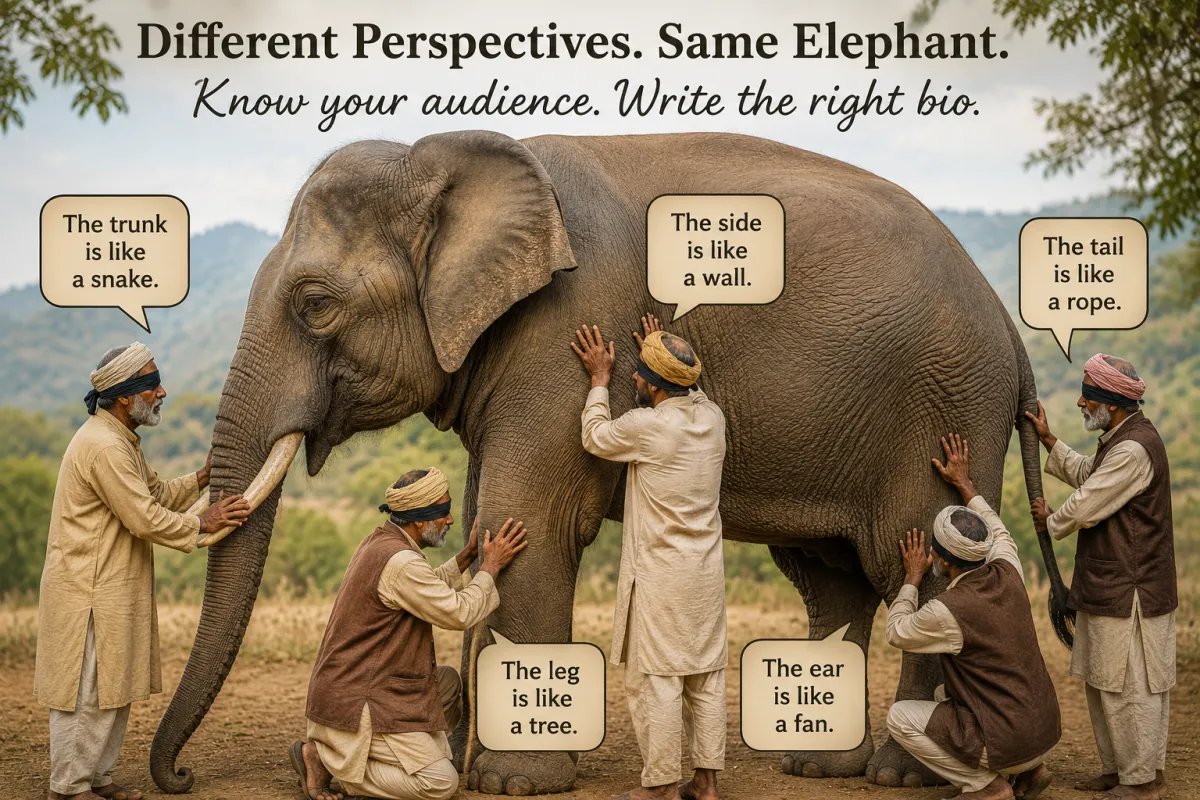
There's an old story about several blind men describing an elephant.
One touched the trunk and insisted an elephant was like a snake.
Another touched the leg and said it was like a tree.
Another felt the tail and described it as a rope.
Another touched the ear and said it was like a fan.
Each person was describing the same elephant, but from a different perspective.
Your audience works much the same way.
A conference planner may be interested in your speaking experience.
A podcast host may focus on your expertise.
A reader may be interested in your books.
A business organization may care about your professional background.
They're all looking at the same person—you—but from different angles.
That's why your bio should emphasize the aspects of your story most relevant to the audience you're addressing.
You aren't changing who you are.
You're simply helping each audience see the part of the elephant that matters most to them.
Don't Write a Boring Bio
For goodness' sake, we're authors.
We're the kings and queens of words.
Surely we can write about ourselves in third person and give readers a glimpse of who we are.
One of the biggest mistakes I see is authors writing bios that sound stiff, formal, and completely disconnected from their personality.
If you're a storyteller, your bio should sound like a storyteller wrote it.
If you write humor, your bio should include a little humor.
If your speaking style feels like a conversation over a cup of coffee, your bio should feel warm and approachable.
I know that's true for me.
I never want an audience to read a polished, corporate bio and then discover a completely different person when I step on stage.
I want my bio to reflect who I really am.
My goal has always been for speaking to feel like we're sitting together over coffee having a conversation.
Your bio should create an accurate expectation of what people will experience when they meet you.
The best bios don't just tell people what you've done.
They give people a glimpse of who you are.
What Should You Include?
Your bio should answer a few basic questions:
Who are you?
What do you do?
Why should someone listen to you?
What makes your perspective unique?
For me, that might include:
Six-time published author
Speaker
Business Coach for Aspiring Authors
Navy Brat
Army wife
Author Relations Coordinator at CrossRiver Media
Passion for helping authors navigate the business side of writing and publishing
Not every bio needs every detail.
The length determines what stays and what goes.
Keep Your Bio Current
One mistake authors make is creating a bio and never updating it.
As your career grows, your bio should grow too.
Review it periodically.
Add:
New books
Awards
Certifications
Speaking experience
Professional accomplishments
A bio is a living document.
Store It Where You Can Find It
Remember our discussion about systems?
Your bio deserves a place in your resource system.
Create a folder that contains:
50-word bio
100-word bio
250-word bio
Speaker introduction
Headshots
Book covers
Media kit
Speaker one-sheets
When someone asks for information, you'll know exactly where to find it.
That's gold.
Not only does it save time, but it demonstrates professionalism.
Learn From the Pros
One lesson I learned as a graduate of the National Speakers Association Academy is that professional speakers are prepared before opportunities arise.
They have their bios ready.
Their headshots ready.
Their media kits ready.
Their introductions ready.
Preparation creates confidence.
It also creates opportunities.
The easier you make it for event planners, podcast hosts, editors, and media professionals to work with you, the more likely they are to do so.
If you'd like to see an example of how these materials can work together, visit my Speaker Page and Media Kit resources.
Your Next Waypoint
Don't wait until someone asks for a bio.
Create one now.
Then create three more versions.
Store them in a folder.
Update them regularly.
Future you will be grateful.
And the next time someone asks for your bio, you'll be able to send it in minutes instead of scrambling to write one from scratch.
Related Compass Stops
The Beginner Author's Media Kit: What to Include
How Authors Can Find Speaking Opportunities Using Their Books
Why Every Author Needs a Simple Follow-Up System
Additional Resource
If you're not sure what materials belong in a speaker resource system, take a look at my speaker page, where you'll find examples of bios, media kit resources, and speaker information:
If speaking is part of your future plans, I encourage you to explore the resources available through the National Speakers Association:
Related Resource
Need a clearer next step for your author journey? Explore DeeDee Lake’s Author Resources for practical tools, encouragement, and guidance for the business side of writing.
Explore Author Resources:https://deedeelake.com/author-resources