
The Benefit of the Doubt in Marriage
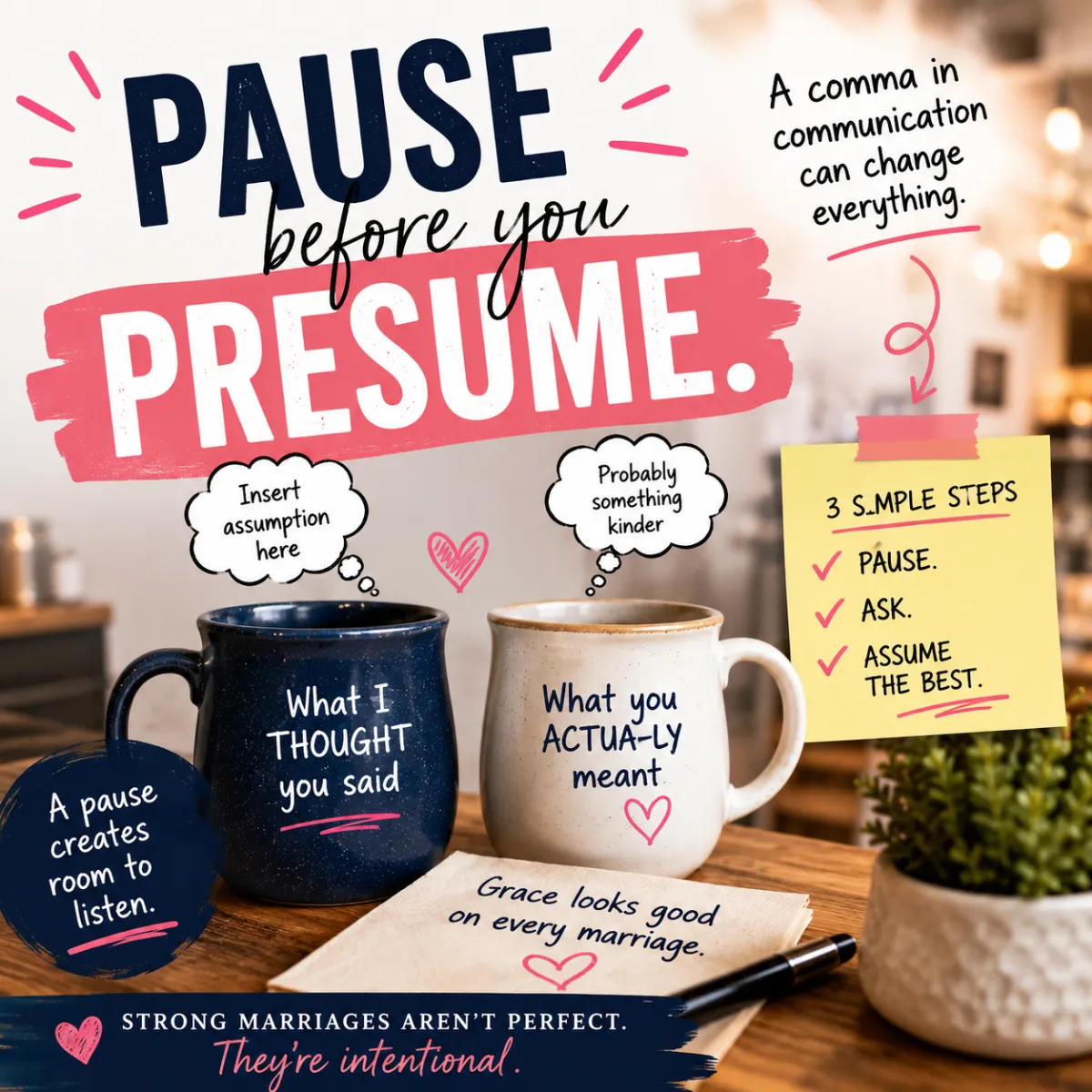
Pause Before You Presume
As a writer, I probably think about grammar and punctuation more than the average person.
I often joke that I could never be an editor because I believe commas should simply go wherever you pause.
English teachers everywhere may now need a moment to recover.
And if you had a conversation with my younger self, you would understand the problem with my punctuation philosophy. I spoke enthusiastically, quickly, and rarely paused long enough to take a breath.
Apparently, my sentences weren't the only things that needed commas.
Over the years, I've learned something important about pausing—not only in writing, but in relationships.
Sometimes a pause gives us just enough time to make sure we heard what we thought we heard.
Sometimes it gives the other person time to explain what they meant.
Sometimes it prevents us from reacting to something that was never actually said—or never meant the way we interpreted it.
A pause creates room to listen.
And in marriage, that little bit of space can make an enormous difference.
Why Do We Assume the Worst About Someone We Love?
Maybe your spouse walks into the room and says something that sounds a little short.
You think:
What's his problem?
Or she doesn't answer your text.
She's ignoring me.
Your husband forgets something you asked him to do.
He doesn't care about what's important to me.
Your wife gives you that look.
Well...
Okay. Sometimes you may want clarification on the look. 😂
But here's the problem.
We can move incredibly quickly from:
What happened
to
What I think it means
to
Why I think you did it.
And suddenly we've created an entire story about our spouse's motives without ever asking whether the story is true.
That's where one of the simplest lessons Seth and I have learned in marriage becomes so important:
Pause Before You Presume
Seth and I have committed to assuming the best about each other.
The best motives.
The best support.
The best encouragement.
That doesn't mean we believe either of us is perfect.
Forty-plus years of marriage has provided sufficient evidence to dismiss that theory.
It means that when something doesn't make sense, our first response isn't automatically:
He meant to hurt me.
She doesn't care.
He was being selfish.
She should have known better.
Instead, we try to begin with what years of knowing each other have already shown us to be true.
That became very clear to me one day in one of the strangest conversations I've ever had.
The Day a Stranger Tried to Convince Me My Husband Was Talking About Me
My husband loves a good deal.
So, naturally, he enjoys thrift stores.
One particular thrift-store clerk had seen Seth several times and was familiar with him. She had only recently met me, but she knew we were married.
One day, Seth walked outside while I remained in the store.
The clerk turned to me and began telling me that my husband had been saying bad things about me.
At first, I more or less nodded.
It was such a strange conversation that I wasn't quite sure what to do with it.
But she kept going.
She insisted Seth had said derogatory things about me.
And very quickly, something inside me went:
Nope.
I knew my husband.
I knew his character.
I knew how he spoke about me when I was there, and I knew the kind of man he was when I wasn't.
So I told her plainly that Seth would never say those things about me—especially to someone he barely knew.
She insisted he had.
I insisted he hadn't.
Enter my sister.
Seth came into her life when she was sixteen, and as far as she's concerned, her big brother can do very little wrong. She immediately joined me in defending him.
The poor thrift-store clerk now had two determined women informing her that she had the wrong man.
We eventually left the store a little miffed by the whole bizarre encounter.
But here's what I remember most:
I never wondered if the woman might be right.
Not because my husband is incapable of making mistakes.
Not because we've never hurt one another's feelings.
Not because our marriage has somehow escaped misunderstandings.
I simply knew his heart well enough to know the accusation didn't fit the man I knew.
What a gift that is in a marriage.
What Does Giving Your Spouse the Benefit of the Doubt Mean?
Giving your spouse the benefit of the doubt means refusing to assign a negative motive when you don't have enough information to know that motive is true.
It doesn't mean ignoring genuine problems.
It doesn't mean excusing harmful behavior.
And it certainly doesn't mean never addressing something that hurt you.
It means you don't automatically fill in the missing information with the worst possible explanation.
Instead, you pause.
You ask.
You listen.
And when you don't yet know the motive, you begin with grace.
Focus on the Family recommends this very practice in its marriage resources: seek to understand your spouse's perspective, give your spouse the benefit of the doubt, listen without interrupting, repeat back what you heard, and ask questions when you need greater understanding.
The Gottman Institute makes a similar recommendation: ask questions rather than making assumptions about what your spouse meant.
In other words:
Pause before you presume.
Sometimes We Really Didn't Hear What We Thought We Heard
This lesson has an additional layer in our house.
I've been deaf on and off throughout my life.
And now Seth has hearing damage too.
Let's just say communication at our house occasionally requires instant replay.
Because of my hearing loss, I've heard some truly funny things over the years that were nowhere close to what the other person actually said.
Fortunately, I've learned to ask:
“Did you say...?”
And sometimes the answer leaves both of us laughing.
But I've realized there's a relationship lesson hidden inside those moments.
Hearing incorrectly and interpreting incorrectly aren't all that different.
In one situation, our ears fill in the blank.
In the other, our emotions do.
And emotions aren't always reliable translators.
What Does the Bible Say About Pausing Before We React?
James 1:19 gives believers a wonderfully practical pattern for relationships: be eager to listen, deliberate about speaking, and slow to anger.
Notice the order.
Listen first.
Speak second.
Anger gets the slow lane.
That's probably not accidental.
Philippians 4:8 also reminds us to direct our thoughts toward what is true, honorable, right, lovely, commendable, and worthy of praise.
That gives us an important question when we're tempted to assume the worst:
What do I actually know is true?
Not:
What am I afraid is true?
What did I immediately assume?
What story did my emotions create?
What do I know?
There may be a real issue that needs to be addressed.
But wouldn't you rather address the real issue than argue over a motive your spouse never had?
Three Steps to Stop Assuming the Worst in Marriage
The next time something your spouse says or does doesn't sit quite right, try this:
1. Pause
Before responding, separate the facts from your interpretation.
Ask yourself:
What actually happened—and what have I added to the story?
That little comma in the conversation may keep a misunderstanding from becoming an argument.
2. Ask
Instead of accusing, get curious.
“I'm not sure I understood what you meant. Can you explain?”
“Did I hear you correctly?”
“When you said that, I took it this way. Is that what you meant?”
Questions invite conversation.
Accusations invite defense.
3. Assume the Best
When you don't have evidence of a harmful motive, let your spouse's character and your shared history matter.
Maybe he forgot.
Maybe she misunderstood.
Maybe he's exhausted.
Maybe she thought she had already told you.
Maybe the words simply came out wrong.
Haven't we all had moments when what came out of our mouths wasn't quite what our brains intended?
I've had enough of those to fill a book.
Possibly several.
Giving the Benefit of the Doubt Doesn't Mean Being Naive
This distinction matters.
Giving your spouse the benefit of the doubt isn't pretending your spouse can never hurt you.
It's refusing to assign a harmful motive before you know one exists.
Trust is built through consistent character, honesty, faithfulness, and actions over time.
If there is an established pattern of deception, abuse, manipulation, or unsafe behavior, simply assuming the best is not an appropriate substitute for addressing the problem and seeking wise support.
But in a healthy relationship, choosing a generous interpretation can prevent countless unnecessary conflicts.
Focus on the Family describes grace in marriage in much the same way: instead of assuming a spouse's motives, grace seeks to understand where the other person is coming from.
That's the marriage I want.
Not one where Seth and I never misunderstand each other.
Good luck with that.
I want the kind of marriage where a misunderstanding doesn't automatically become an indictment of the other person's character.
A Pause Can Communicate More Than Words
I've come a long way from the girl who rarely paused long enough to breathe.
I'm still enthusiastic.
I'm still a talker.
And I'm still not volunteering to edit your commas.
But I've learned that pauses have value.
A pause can communicate peace.
A pause can communicate:
I want to understand.
I'm not going to rush to judgment.
What you're saying matters to me.
You matter to me.
Sometimes a comma in communication says, “You matter enough for me to make sure I understood you.”
That's a pretty powerful little punctuation mark.
Your Relationship Compass Check
Think about your last misunderstanding with someone you love.
Ask yourself:
Did I respond to what actually happened—or to what I presumed it meant?
Then try this simple practice this week:
Pause. Ask. Assume the best.
Because the person you love deserves the opportunity to explain their own heart before you write the story for them.
Pause before you presume.
Sometimes that one little comma creates exactly enough room for grace.
Related Faith & Relationship Posts
Continue exploring healthy communication and stronger relationships:
Frequently Asked Questions
What does giving your spouse the benefit of the doubt mean?
It means choosing not to assign a negative motive when you do not have enough information. Instead, pause, ask questions, listen, and seek to understand before reacting.
How can I stop assuming the worst about my spouse?
Separate what actually happened from what you think it meant. Pause before reacting, ask for clarification, and consider the most gracious reasonable explanation.
What does the Bible say about listening in marriage?
James 1:19 teaches believers to be quick to listen, slow to speak, and slow to anger. That creates a strong biblical pattern for healthy communication in marriage.
Reader Question
When has pausing to ask one more question changed the way you understood someone you love?