
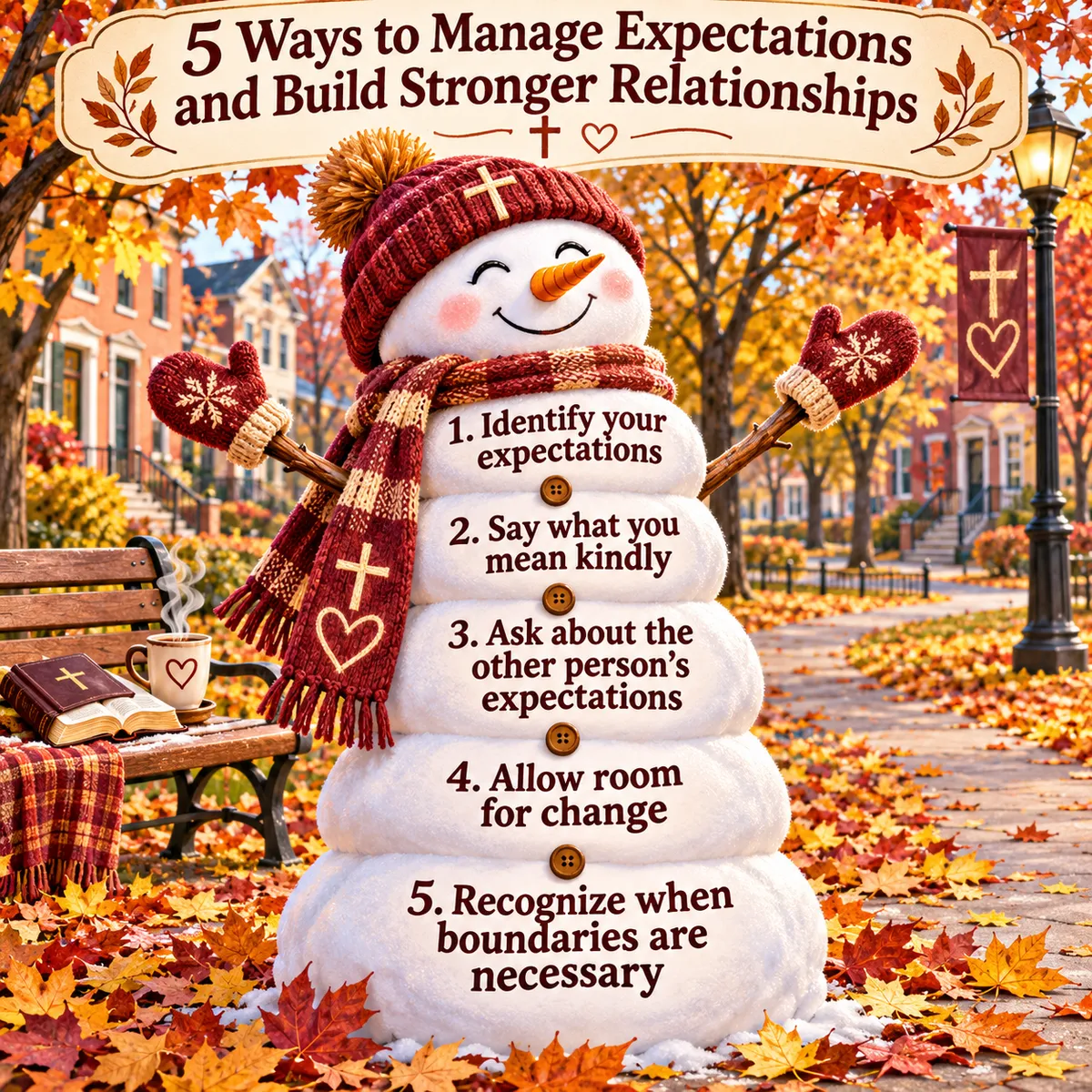
5 Ways to Manage Expectations and Build Stronger Relationships
5 Ways to Manage Expectations and Build Stronger Relationships
When expectations go unspoken, misunderstandings often do the talking.
Have you ever been disappointed because someone didn't do something you expected?
Maybe your spouse didn't remember an important date. Your friend didn't call when you thought she should. Or your children completely overlooked something that seemed painfully obvious to you.
And there you are, wondering how someone who knows you so well could possibly miss something so important.
Meanwhile, the other person has absolutely no idea what went wrong!
Welcome to the wonderful world of unspoken expectations.
It's a place where everyone thinks they're following the rules, but nobody received the instruction manual.
After decades of marriage, I've learned that expectations can either strengthen relationships or create unnecessary frustration. Much depends on whether we communicate them clearly.
The Invisible Rulebook
Every relationship comes with expectations.
Some are reasonable and important: honesty, respect, faithfulness, and kindness.
Others develop from family traditions, childhood experiences, personal preferences, and habits.
One person grows up in a family where birthdays are practically national holidays. Another comes from a family where someone might remember your birthday somewhere between breakfast and Christmas.
Neither person necessarily loves the other any less.
But without communication, disappointment can arrive faster than a package marked overnight delivery.
The problem isn't always that our expectations are unreasonable.
Sometimes it's that we expect people to know things we've never actually told them.
When Two Different Personalities Share One Life
In military life, I've known families who carefully planned every move, meal, and milestone.
I've also known people whose philosophy was something like, "We'll figure it out when we get there."
Both approaches have advantages.
A planner can bring organization and security. A flexible personality can bring adaptability and peace when plans change.
But put those two approaches together without conversation, and the resulting confusion could qualify as a military training exercise!
The goal isn't to make everyone think alike.
The goal is to understand what matters to the people we love.
That's especially important in marriage, but it also applies to friendships, church relationships, and extended families.
Expectations Are Not Mind Reading
Here's a question worth asking:
Have I communicated what I need, or have I simply assumed the other person should know?
There is an enormous difference.
Saying, "You never spend time with me," invites defensiveness.
Saying, "I'd love for us to have dinner together without our phones a couple of evenings each week," provides a clear invitation.
One communicates frustration.
The other communicates a possible solution.
Of course, the conversation also requires listening.
Perhaps the other person has needs or limitations you haven't recognized.
Healthy relationships make room for both perspectives.
What Does Scripture Say?
James 1:19 (KJV) reminds us:
"Let every man be swift to hear, slow to speak, slow to wrath."
That's excellent advice for navigating expectations.
Before deciding someone doesn't care, we can ask questions.
Before responding defensively, we can listen.
Before assuming someone's intentions, we can seek understanding.
Not every disagreement disappears when we communicate clearly, but communication gives us a better chance of addressing the actual problem.
And sometimes the problem wasn't what we thought it was at all!
Five Ways to Manage Expectations with Grace
1. Identify your expectations.
Ask yourself what you truly need and what you simply prefer.
There is a difference between expecting honesty and expecting everyone to load the dishwasher exactly your way.
2. Say what you mean kindly.
Clear communication is a gift. Don't make someone solve a mystery when you can provide directions.
3. Ask about the other person's expectations.
Relationships are partnerships, not one-way instruction manuals.
4. Allow room for change.
Life changes. Families grow. Health, responsibilities, and circumstances shift. Expectations that worked five years ago might need adjusting today.
5. Recognize when boundaries are necessary.
Grace does not require accepting repeated disrespect or harmful behavior. Healthy boundaries protect relationships by clarifying what is and isn't acceptable.
Make Room for the Conversation
One of the principles behind extraordinary relationships is intentionality.
We cannot build strong connections entirely on assumptions.
That doesn't mean scheduling a two-hour family meeting every time someone forgets to replace the toilet paper.
Although, depending on your household, that might be tempting!
It means having honest conversations before small disappointments grow into major misunderstandings.
Try asking someone important to you:
"What is one thing I could do that would make you feel more supported or appreciated?"
Then listen.
You might be surprised by how simple the answer is.
Your Relationship Challenge
This week, identify one expectation you've been carrying without clearly communicating it.
Choose a good time to discuss it with kindness and curiosity.
Then ask the other person what they need from you.
Extraordinary relationships aren't built by expecting perfection. They're built by choosing understanding, honesty, and grace.
Frequently Asked Questions
Are expectations unhealthy in relationships?
No. Reasonable expectations such as honesty, reliability, and respect are important. Problems arise when expectations are unclear, unrealistic, or one-sided.
How do I communicate expectations without sounding demanding?
Use specific, respectful language. Explain what matters to you, invite the other person's perspective, and work toward an agreement.
What if my spouse or friend doesn't share my expectations?
Explore why each expectation matters. Look for reasonable compromises while maintaining boundaries around essential needs and respectful treatment.
Can expectations change over time?
Absolutely. Different seasons of life often require new conversations and adjustments.
Continue Exploring
Explore more relationship encouragement in Faith & Relationships.
For another perspective on building understanding, visit The Gottman Institute.
Your turn: What's one expectation that became easier to manage once you talked about it?
Relationships are built one conversation at a time!